Social Media – What is it? Part 2.
Participate On Other Blogs
It might seem counter-intuitive for you to spend your valuable time by participating in discussions on other people’s blogs, but the payoff can be very valuable. Remember that it takes time to build a reputation and establish your credibility, and you can’t always expect everyone to come to you. Sometimes, you have to go out and build your own credibility and reputation.
Basic Strategy:
Identify 2-3 blogs in your industry, or those that focus on small business, and get into the habit of regularly reading the content and participating in the discussions. Whenever you can, try to add value by sharing a personal story about what has/has not worked for you. Get to know the writers – they’ll be valuable contacts for you. One strategy for identifying good blogs is to use Guy Kawasaki’s Alltop, which is a directory of popular blogs across many different subject areas. For example, for blogs focused on crafts, you might follow this page on Alltop. If you want to participate in blogs focusing on small business issues, you might start at Technorati’s list of the Top 100 Small Business blogs.
Advanced Strategy:
Once you’ve spent some time on other blogs and have participated in discussions, you’ll find that you’ve built a level of credibility and trust, based on your participation. You should consider reaching out to the blog owners and asking whether they’d allow you to guest post an article on their blog (kind of like this post). This is a nice way for you to get in front of a bigger audience, and many blog owners will invite guests to post from time to time. Agree on a topic in advance and provide a draft of your post sufficiently in advance of the publication date to give them an opportunity to review.
Alternatively, ask if they would consider guest posting on your blog. Since you’re looking to attract more readers (and more potential customers), either option works well for that purpose. Don’t worry so much about going after the A-list blogs right away. There are many excellent blogs and it might take a bit of time to build your reputation to such a level that you’ll have opportunities to post in the top blogs. That doesn’t mean you should wait, though – make opportunities for yourself and offer to guest write whenever you can find a new audience. I recommend you read How To Guest Post To Promote Your Blog from blogging expert Darren Rowse.
Mobile Social Networks and other Local Strategies
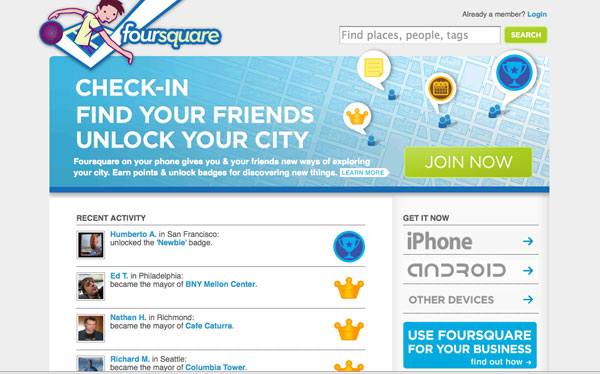
Yelp publishes millions of reviews about local businesses. Foursquare is a combination city-guide, friend finder and competitive game. It allows users to “check in” by cell phone at a local venue and announce this via other social networks such as Twitter.
Basic Strategy:
Yelp, Foursquare, and other mobile social networks can be powerful marketing channels for small businesses. You should at the very least register accounts on the popular services and get to know them. If you have a restaurant or a retail store, for example, you’ll want to get to know Yelp pretty well. You can set up a business account on Yelp (no cost), which will let you answer questions about your business, track how many Yelp users view your business page, add information about your business, and announce special promotions. Similarly, you’ll want to sign up with Foursquare to take advantage of local advertising opportunities. Using Foursquare, you’ll be able to push promotions to potential customers who’re in the vicinity of your business.
You should also consider other local strategies. For example, you can add your business to Google Maps, or update your listing to include additional details. You can do the same on Bing.
Advanced Strategy:
If you believe that your business can truly benefit from a presence on Yelp, Foursquare, or similar networks, you’ll want to do more than just register accounts with those services. For example, Yelp allows you to include a website URL for your business. Nearly all sites will let you upload photos to your profile, and photos will make your profile more trustworthy.
You can also proactively use Yelp and other similar services to promote your business. Ask your customers, friends and family who have used your services for a review on Yelp. You can encourage reviews by running promotions or discounts – offering free appetizers, for example, to a customer who will write a review about their meal at your restaurant (or to one who already wrote a review), or a small discount to a customer who hires you for carpentry work and mentions that they found you through Yelp.
Similarly, you can find ways to promote your business using Foursquare and similar networks. If you have a TV display in your store connected to a computer, you can display the people who are checking in. You can offer specials or discounts to the person who visits your location the most (this is similar to frequent buyer cards that many businesses have used for years).
Don’t forget to also consider how you can improve your use of other basic local strategies. For example, many small business websites are optimized for specific keywords or subject areas, but are rarely optimized for local searches. If you have a gift basket business, you’ll want to be sure that users searching for gift baskets in your geographic area will find you.
Comments and Conversations About Your Company
Whether or not you are a party to the conversations, people will talk about your company. How do you monitor and, when appropriate, join those discussions?
Basic Strategy:
There are five simple steps you can take today to begin paying attention to conversations about your business.
- Set up Google Alerts. Google Alerts are free email updates from Google search results about any topic you’re interested in tracking. For example, I track, among other alerts, the names of our competitors, the name of our company, and certain other terms I believe are important to my business. Anytime Google adds something to its index that mentions my company or the other terms I’m tracking, I receive an immediate email notification with a link to that item. Alerts can be set up for web, blog, news, video, or groups searches.
- Review the results in your web analytics data. At my company, we use Google Analytics. Google Analytics is a free tool from Google that provides detailed and very useful information about your website traffic and the effectiveness of your marketing efforts. When we run social media campaigns, we’ll often attach tracking tags to those campaigns so that we can properly monitor them in Google Analytics. This is important because without such data it will be nearly impossible for you to evaluate the success of your social media marketing efforts. But analytics are important for another reason: they’ll tell you which sites are sending traffic to your site.
- Search Facebook. In August, Facebook rolled out a real-time search engine (the search box is on the top right of any Facebook page). One effective way to take advantage of Facebook search is to search for your company’s name to see who is talking about your company and what they’re saying. In several months, you’ll be able to search Facebook updates directly from Bing, which will be integrating Facebook public updates into Bing’s search results.
- Search Twitter. You currently can search Twitter for real-time results (if you’re not logged in, just go to Twitter’s homepage). One easy way to monitor conversations about your company is to search for your company’s name. You can also currently do this on Bing, which is indexing Twitter updates. Very soon, you’ll also be able to search Twitter updates (and other social media content) via Google’s Social Search (Social Search was rolled out to Google Labs recently, as an experimental product). You can also use Twitter clients like TweetDeck or Seesmic to save searches and monitor in real-time whenever someone uses a specific word or phrase in a tweet.
- Take advantage of services that will, similar to Google Alerts, push data to you. I use and like BackType, which is a real-time search engine that indexes online conversations in thousands of blogs and social networks. I use BackType primarily to keep up with conversations in blogs. Every day, I receive emails from BackType with links to comments that include the keywords I’m monitoring. Without these alerts, I would be unable to monitor so many blogs, and my ability to respond to posts about my company would be very limited.
- 1. to comments that include the keywords I’m monitoring. Without these alerts, I would be unable to monitor so many blogs, and my ability to respond to posts about my company would be very limited.
Advanced Strategy:
If you’re having trouble keeping track of your various search strategies, you should consolidate your efforts and leverage one of the many applications that will help you monitor the social web. I have not personally used these services, but they appear to be held in high esteem by knowledgeable people who have. For example, truVOICE provides keyword monitoring of the social web with an emphasis on blogs and forums, while Radian6 pulls in a lot of information from the social web, analyzes it, and provides consumer sentiment ratings for your brand. A good resource to learn about paid social media monitoring tools is Mashable’s post Top 10 Reputation Tracking Tools Worth Paying For.
In addition to monitoring, you’ll need to decide how, when, and where you’ll engage in conversations. It’ll be very difficult for you to engage in conversations everywhere, so you should spend some time learning the various networks and deciding where you should focus your efforts. Looking at your website analytics data — if you own an online business — will help a great deal because it’ll help you to better understand where your traffic is coming from. If much of your traffic originates from Twitter and Facebook, for example, you’ll want to spend more time on those services.


Trackbacks & Pingbacks